
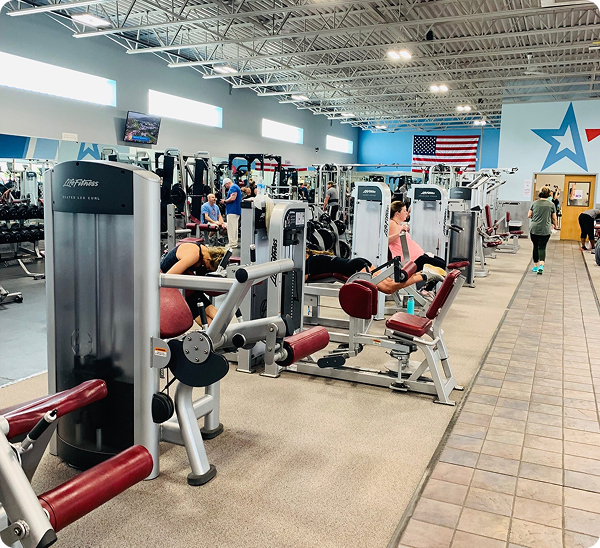
Walking into the strength-training area of a gym for the first time can feel overwhelming. You may see rows of machines, racks of dumbbells, barbells, benches, cables, and other equipment without knowing where to begin.
One of the most common questions new gym members ask is whether beginners should use machines or free weights. The simple answer is that both can be effective. Weight machines provide stability and make many movements easier to learn, while free weights help develop coordination and allow your body to move more naturally.
You do not need to choose one forever. In fact, many beginners benefit from using a combination of machines and free weights as they build confidence, learn proper form, and discover which exercises feel best for their bodies.
What Is the Difference Between Machines and Free Weights?
Strength-training machines guide the weight through a set path. Examples include the leg press, chest press, seated row, leg curl, and lat pulldown. Most machines include a seat, pads, handles, and a weight stack or plate-loading system.
Free weights are not attached to a fixed movement path. Dumbbells, barbells, kettlebells, and weight plates all fall into this category. Because you control the direction of the weight, your muscles must work together to stabilize the movement.
Both types of equipment create resistance that can help your muscles grow stronger. Their primary differences involve stability, freedom of movement, learning curve, and the amount of coordination required.
Benefits of Weight Machines for Beginners
Machines can be an excellent starting point for someone who is new to strength training.
Machines Provide More Stability
Because the equipment guides the movement, you do not have to stabilize the weight as much as you would with a dumbbell or barbell. This can make it easier to focus on the muscle group you are training.
The additional stability may also feel more comfortable for beginners who are still developing balance and coordination.
Machines Can Be Easier to Learn
Many machines include diagrams showing how to adjust the equipment and perform the exercise. Once the machine is set up correctly, the fixed movement path can make the exercise more approachable.
Instructions on a machine are not a substitute for professional guidance, however. If you are unsure how to adjust the seat, select the resistance, or position your body, ask a trainer or knowledgeable staff member for help.
Machines Make It Simple to Adjust Resistance
On many machines, changing the resistance is as easy as moving a pin within the weight stack. This makes it convenient to begin with a manageable weight and increase it gradually.
Machines Can Target Specific Muscle Groups
Machines can help you focus on a particular area, such as your quadriceps, hamstrings, chest, shoulders, or back. This can be useful when you are learning how different muscles contribute to a balanced workout.
Limitations of Weight Machines
Although machines are useful, they also have limitations.
The fixed movement path may not fit every body equally well. Seat height, handle position, limb length, and mobility can affect how comfortable a machine feels. Adjust the equipment before beginning, and stop if a movement causes pain.
Machines may also require less work from the smaller stabilizing muscles that help control movement. This does not make machines ineffective. It simply means they train the body differently from free weights.
Finally, a machine-based exercise may not always carry over to everyday movement as directly as an exercise that requires you to control resistance through space.
Benefits of Free Weights for Beginners
Free weights can also be appropriate for beginners, especially when the exercises are selected carefully and performed with manageable resistance.
Free Weights Build Coordination and Stability
When you lift a dumbbell or kettlebell, your body must control both the weight and its path. This recruits stabilizing muscles and helps develop coordination.
Free Weights Allow Natural Movement
Free weights give you more control over the angle and path of an exercise. This flexibility can make it easier to find a comfortable movement pattern, although it also requires greater awareness and control.
Free Weights Are Versatile
A small selection of dumbbells can be used for squats, rows, presses, lunges, carries, and many other exercises. This makes it possible to train the entire body without moving between numerous machines.
Free-Weight Exercises Can Support Everyday Strength
Exercises such as squats, carries, and rows involve controlling your body and an external load at the same time. These patterns can help build strength for everyday activities such as lifting, carrying, reaching, and getting up from a chair.
Limitations of Free Weights
Free-weight exercises generally involve a larger learning curve. Good technique requires an understanding of posture, joint position, range of motion, and control.
Choosing too much weight can make it difficult to maintain proper form. Some barbell exercises may also require a spotter, safety equipment, or coaching.
Beginners do not need to start with complex lifts. Bodyweight movements and light dumbbells can provide plenty of challenge while you learn the fundamentals.
Machines vs. Free Weights for Beginners: A Quick Comparison
| Factor | Weight Machines | Free Weights |
| Stability | Equipment provides more support | Your body controls and stabilizes the weight |
| Learning curve | Often easier to begin | Usually requires more technique |
| Movement path | Fixed or guided | Flexible and self-directed |
| Muscle focus | Useful for isolating specific muscles | Often trains several muscles together |
| Adjusting resistance | Usually quick and simple | Requires selecting or changing weights |
| Versatility | One machine usually serves a limited purpose | One weight can support many exercises |
| Beginner suitability | Very approachable | Appropriate with simple exercises and good form |
Should Beginners Start With Machines or Free Weights?
Beginners who feel unsure about strength training may want to start with machines. The added stability can make it easier to learn basic movement patterns and become familiar with resistance training.
That does not mean beginners need to avoid free weights. Simple exercises with light dumbbells can be introduced from the beginning, especially with instruction. A dumbbell goblet squat, supported one-arm row, seated dumbbell press, or farmer carry may help a beginner develop coordination without requiring advanced technique.
The best choice depends on several factors:
- Your current experience and confidence
- Your fitness goals
- Your balance and mobility
- Your injury history or physical limitations
- The exercises you enjoy
- Whether qualified guidance is available
If you have an injury, health condition, or significant movement limitation, speak with an appropriate healthcare or fitness professional before beginning a new strength program.
How to Combine Machines and Free Weights
A balanced beginner workout can use machines for stability and free weights for coordination and versatility.
For example, a beginner full-body session might include:
- Five to ten minutes of easy cardio and dynamic movement
- Leg press machine
- Seated row machine
- Dumbbell goblet squat or a supported bodyweight squat
- Chest press machine
- Light dumbbell Romanian deadlift with instruction
- Farmer carry with light dumbbells
- A brief cooldown
This is only an example. Exercise selection should reflect your abilities, goals, and access to equipment.
You might also use a machine when learning a new muscle group, then gradually introduce a related free-weight movement. For example, you could begin with a machine chest press before trying a dumbbell chest press with appropriate guidance.
Beginner Strength-Training Tips
Learn the Movement Before Adding More Weight
Start with a resistance that allows you to move with control. You should be able to complete each repetition without rushing, swinging the weight, or changing your posture dramatically.
Adjust Every Machine
Do not assume the previous person’s settings will fit you. Adjust the seat, pads, and handles so the machine matches your body.
Use a Comfortable Range of Motion
More range is not always better. Use a range you can control without pain or compensation.
Train the Major Muscle Groups
A balanced routine should generally include exercises for the legs, hips, back, chest, shoulders, arms, and core. Avoid focusing only on the muscles you can see in the mirror.
Progress Gradually
You do not need to increase weight during every workout. Progress can also mean improving your form, completing an additional repetition, moving with more control, or becoming more consistent.
Ask for Help
You are not expected to know how every machine works on your first day. A fitness professional can show you how to adjust equipment, select a starting weight, and perform exercises safely.
The Best Equipment Is the Equipment You Can Use Consistently
The debate between machines and free weights does not need a single winner. Machines offer stability, simplicity, and an approachable introduction to strength training. Free weights offer versatility, coordination, and greater freedom of movement.
For many beginners, the best answer is to use both. Start with exercises that feel manageable, prioritize technique, and add complexity gradually as your confidence grows.
At Fitness Premier Clubs, members can access a range of strength and functional fitness equipment along with support from fitness professionals. Whether you feel most comfortable beginning with a machine or picking up your first pair of dumbbells, you can build a routine that meets you at your current level and helps you move forward.
Find your nearest Fitness Premier Clubs location and take the next step toward becoming stronger and more confident in the gym.


